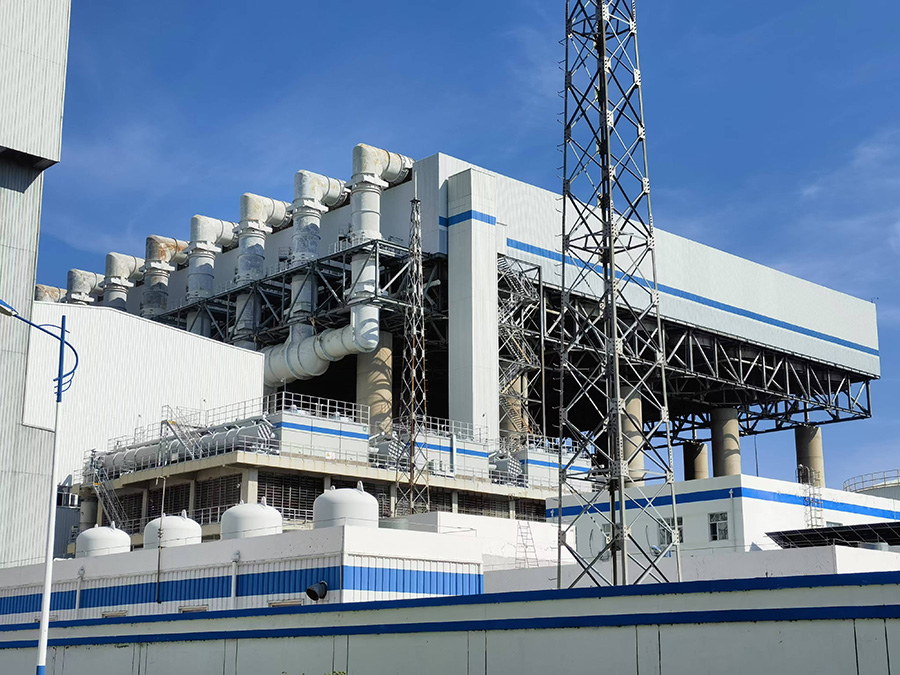
At present, air-cooling systems are mostly applied in the Three-North Regions (Northeast, North, and Northwest China), but most of them have poor actual operation effects. Problems such as high unit back pressure in summer, high energy consumption, and low operating efficiency are particularly prominent. Even though the temperature in this region is relatively low in summer, the application effect is still barely satisfactory. Currently, the No. 2 air-cooling unit of Baicheng Power Plant mainly has the following problems:
1.When the temperature is high in summer, the unit output is restricted, and the load-carrying capacity decreases by 10%~20%, which seriously restricts the economical and safe operation of the unit.
2.The operating back pressure fluctuates greatly, and the actual standard coal consumption for power supply is high.
3.The self-energy consumption is relatively high. Direct air-cooling units are equipped with a large number of fans with high power, and the auxiliary power consumption rate of the fan group in summer exceeds 1%.
4.The heat exchange effect is greatly affected by the environment and seasons. The heat exchange effect of direct air-cooling units is significantly influenced by the external environment: when the temperature is high, the unit output is restricted; strong winds may cause a sudden rise in the steam turbine exhaust pressure, and in severe cases, force the unit to shut down.
5.To solve the problem of poor operation effect of air-cooling systems, most domestic air-cooling power plants currently adopt the method of adding spray devices to the air-cooling system, which spray water onto the air-cooling radiators in various forms, but the actual effect is barely satisfactory.
The heat exchange tubes of the 2×660MW air-cooling island of Baicheng Power Generation Co., Ltd. adopt a three-row tube structure, with the tubes arranged in a staggered manner. The gaps between the tube fins are small. During operation, under the blowing effect of the fans, a large amount of dust, sediment, and flying insects are blown into the gaps of the tubes, which affects the heat exchange of the tubes and causes an increase in the unit operating back pressure. After a long winter operation period, the impurities accumulated on the surface of the tubes gradually harden, making the tubes difficult and time-consuming to clean. Especially in high-temperature weather in summer, the heat exchange performance of the air-cooling tubes cannot be quickly improved, which seriously affects the operational economy and safety of the unit.
Due to the deterioration of the cleanliness of the inner and outer surfaces of the air-cooling tubes, the overall heat exchange performance has shown a downward trend year by year, and the capacity of the newly added peak cooling equipment is insufficient. The design performance is as follows: when the ambient temperature is 30℃ and under rated load, the steam turbine exhaust pressure is 25kPa; when the ambient temperature is 12℃ and under TMCR (Turbine Maximum Continuous Rating) condition, the steam turbine exhaust pressure is 11kPa. However, in actual operation, when the outdoor ambient temperature exceeds 30℃ in summer and the unit load is higher than 520MW, the unit operating back pressure has exceeded 35kPa, making it impossible to achieve full-load output and seriously affecting operational economy and safety.
Based on the current operation status of the unit, after the cold-end optimization and energy-saving transformation of the No. 1 steam turbine, the annual operating back pressure of the unit has been reduced by approximately 1.4kPa, which can effectively reduce the standard coal consumption for power generation by about 3.08g/kWh. This realizes the cold-end optimization of the air-cooling unit, achieves energy conservation and emission reduction effects, and significantly reduces the unit operating cost.
After the capacity expansion transformation of the peak cooling equipment, the operating back pressure under high-temperature conditions in summer has been significantly reduced, which can meet the peak-shaving operation needs of the unit, realize full-output operation, and play a guarantee role in the safe operation of the unit.